Technology leaders are under mounting pressure to deliver change faster, to higher standards of quality and with demonstrably closer alignment to business priorities. At the same time they must control costs in high-cost locations and compete for a limited pool of senior engineering and architecture talent. Traditional operating models that rely on large, distributed delivery organisations frequently produce the opposite of these outcomes. Feedback loops lengthen, context degrades as requirements move through multiple layers, and the business experiences technology as something that arrives late and requires further negotiation rather than as a responsive partner.
These models also carry structural cost and agility penalties. Standing up or scaling a large programme typically requires significant lead time to recruit, onboard and align many people across geographies. Once underway, changes in direction become expensive because the distance between business intent and technical execution has already widened. In fast-moving competitive or regulatory environments the cost of that distance is measured not only in budget overruns but in missed market opportunities and eroded stakeholder confidence.
Mature agentic AI systems now offer a practical alternative. When applied with discipline they allow a small number of highly skilled people, working in close proximity to the business, to generate the throughput, quality and adaptability that previously required much larger teams. The economics shift because the same contextual understanding, structured breakdown of work and continuous validation that once demanded many hands can be augmented and accelerated by coordinated AI agents. For CIOs and CTOs the strategic question is how deliberately to redesign delivery models around this new capability so that speed, cost and business alignment improve together rather than trade off against one another.
A New Operating Model for Scale
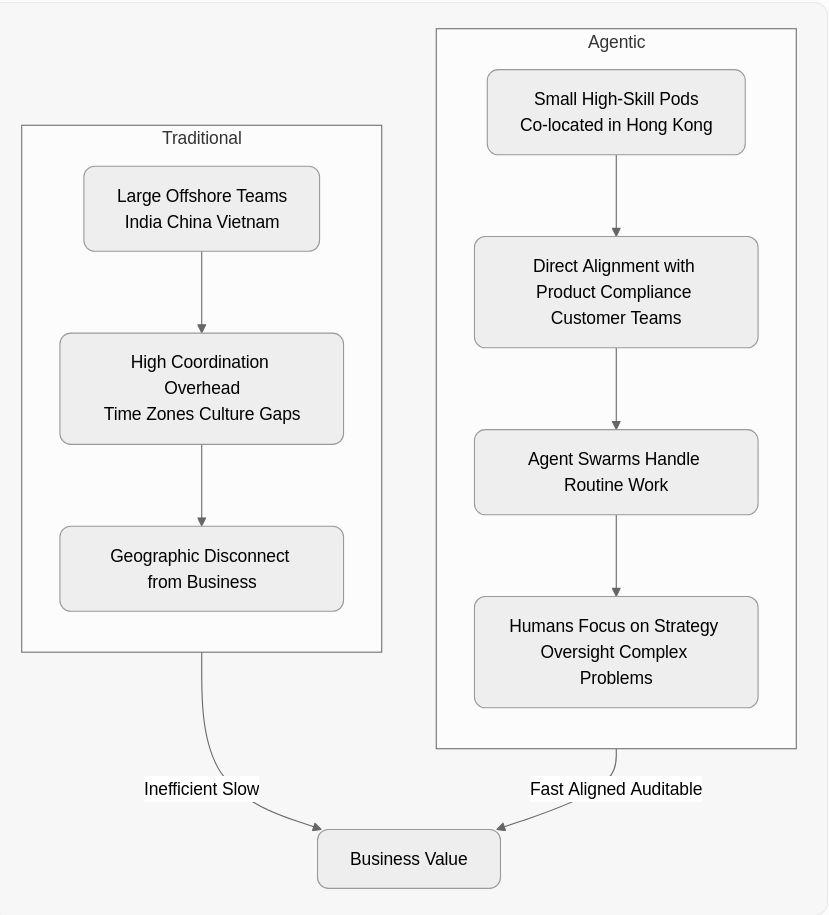
The model rests on a straightforward premise. When advanced AI capabilities are integrated deliberately into the way technology work is organised, a small group of highly skilled people working in close proximity to the business can deliver the throughput, quality and adaptability that once required significantly larger teams. The key is not simply giving individuals better tools, but redesigning the operating rhythm so that context is captured once, work is broken down systematically, validation happens continuously and the business remains directly connected to decisions and progress.
At a strategic level the approach follows four linked phases. The first establishes the foundational awareness the AI systems need: secure, structured access to organisational knowledge, existing documentation and task management so that every subsequent action is grounded in reality rather than generic assumptions. The second shifts into active collaboration, where human and AI work together to shape strategy, surface options and define the right building blocks. The third turns that direction into a precise, executable backlog through iterative agent-assisted breakdown, review and refinement. The fourth moves into sustained delivery, where networks of agents support ongoing work, reviews and dependency management while humans retain architectural control and final accountability.
What distinguishes this model from conventional augmentation is the deliberate preservation of proximity and ownership. Because the core team remains small and co-located with business stakeholders, feedback is immediate, direction can change without bureaucratic lag, and technology decisions stay visibly connected to commercial or operational intent. The AI layer multiplies capacity without inserting distance. The result is not merely faster output but a tighter coupling between the business and technology that traditional large-scale or distributed models struggle to achieve once work has been handed over.
How the Model Works in Practice
The four phases translate the strategic premise into repeatable operational rhythm. The foundation phase creates the shared context the AI systems require, drawing on existing organisational knowledge and documentation so that every later action starts from an accurate understanding of technologies, responsibilities and dependencies. The collaborative phase turns that context into direction through structured human-AI dialogue, surfacing options, testing assumptions and shaping the high-level architecture and priorities. The backlog phase converts strategy into precise, ready-to-execute work items through systematic breakdown, automated drafting and human review. The orchestration phase then sustains delivery by coordinating networks of agents that handle repetitive validation, updates and dependency tracking while humans retain oversight of architecture and quality.
At the heart of sustained scaling sits the orchestration layer. LangGraph is particularly well suited to enterprise requirements because it models agent workflows as explicit, controllable graphs. This design delivers the state management, transparency and human-in-the-loop intervention points that technology leaders need for reliable, auditable delivery. Agents can maintain shared context across long-running processes, critique one another’s outputs and surface issues for human decision without losing coherence or governance. The result is multi-agent collaboration that remains observable and correctable rather than opaque or brittle.
The model does not require every component to come from a single framework. Where specific performance, latency or deployment constraints exist, complementary agent tools can be introduced alongside the primary orchestration layer. The guiding principle remains the same: choose the mechanism that best preserves control, visibility and business alignment while multiplying the capacity of the small core team. In practice this produces faster movement from intent to working software, with fewer hand-offs and a tighter, more responsive relationship between technology execution and business stakeholders.
Evidence from Live Application
A recent engagement provided a clear demonstration of the model in action. The work began with no dedicated team in place and no backlog. A concentrated series of recorded meetings and discussions was held with architecture, engineering, product and programme stakeholders. Transcripts, chat records and supporting materials were combined with the organisation’s existing documentation and task structures. This created the rich, grounded context the AI systems needed to understand technologies in use, team responsibilities and cross-programme dependencies from the outset.
Within approximately two weeks the position had moved from zero visibility to a complete, production-ready backlog comprising 17 epics and more than 200 stories. The stories were produced to a high standard, with around 80 per cent requiring only light refinement to reach full readiness. The low margin of error and overall quality stemmed directly from the AI’s accurate, context-aware understanding of the environment rather than generic or speculative generation.
This outcome illustrates the practical time-to-value the model can deliver. Traditional approaches to standing up a comparable backlog typically require significantly longer elapsed time, multiple rounds of clarification and a larger coordination overhead. Here the combination of captured stakeholder input, structured agent-assisted breakdown and human review produced a high-quality foundation in a fraction of the usual window. The engagement showed that even from a cold start, a small core team supported by the right AI operating rhythm can remove the early bottlenecks that often delay large programmes and can do so while keeping the business directly connected to the emerging shape of the work.
Measuring Impact
At CIO and CTO level the metrics that matter are those that link technology delivery directly to business outcomes. Time to market, delivery velocity, the cost of running the team and the quality of business-technology alignment are not independent variables. Traditional large-scale or distributed models frequently force trade-offs between them: speed is gained at the expense of alignment, or cost is reduced by increasing distance from the business. The AI-augmented small-team model is designed to improve these measures together rather than in opposition.
Time to market improves because a high-quality, ready-to-execute backlog can be established in weeks rather than months, even from a standing start. Velocity rises once development begins, supported by clearer stories, fewer ambiguities and AI-assisted validation within the delivery pipeline. The cost of running the team falls because a small number of senior, well-supported people can sustain throughput that previously required much larger permanent headcount. Most importantly, business-technology alignment strengthens through direct proximity. Stakeholders can see progress, raise issues in real time and steer direction without the delays and distortions of layered hand-offs. This closeness replaces the familiar pattern of requirements being thrown over a wall and returned late with something that needs further negotiation.
These measures reinforce one another. Faster, clearer backlogs reduce wasted effort and rework, which in turn improves velocity and lowers effective cost. Direct business involvement surfaces the right priorities early, which improves both time to market and stakeholder confidence. The net result is an organisation that can respond more quickly to changing needs while maintaining tighter control over spend and quality. For technology leaders this combination represents a material shift in the unit economics and responsiveness of delivery.
Preparing the Organisation
Adopting this operating model is not simply a matter of introducing new tools. It represents a change in methodology that requires deliberate investment in people alongside technology. The AI layer multiplies capacity only when the humans involved know how to direct it, review its outputs critically and integrate it into their daily rhythm. Without that capability the benefits remain partial and the risk of over-reliance or inconsistent results increases.
The requirement extends beyond the core delivery team. Developers need hands-on practice in steering agents and validating generated work. Product colleagues and scrum masters benefit from understanding how AI-assisted breakdown and validation change planning and prioritisation. Stakeholders outside the immediate team also need sufficient familiarity to engage confidently with the new pace and visibility of progress. Structured AI literacy training combined with practical workshops provides the foundation. Regular show-and-tells, clear communication of early wins and visible thought leadership from senior technology and business sponsors help embed the approach across the wider organisation.
The most effective rollouts treat this as an integral part of the pilot rather than a separate workstream. By starting with a contained scope, demonstrating tangible results quickly and folding training into the actual work, organisations build capability without creating parallel overhead or disrupting existing commitments. Visible leadership support signals that the change is strategic rather than experimental. When this preparation is done well the model scales more smoothly, adoption is faster and the organisation gains both the technical and cultural capacity to sustain the new way of working.
Cost, Sustainability and Tool Selection
High-cost locations remain attractive for this model precisely because the team size is small and engagements can be time-bounded. Rather than building and maintaining large permanent structures, organisations can stand up focused capability for defined periods, deliver the required outcomes and then right-size or redeploy. This flexibility improves the economics of technology delivery, particularly where demand is variable or where new initiatives need to prove value before scaling.
Running agent networks does introduce incremental operational cost, so disciplined control is essential. The most effective approach is to match the model to the task rather than defaulting to a single high-capability option for everything. Initial scaffolding and exploratory work can be handled efficiently by one class of model, while day-to-day iterative development and refinement benefit from a different balance of speed and cost. Specialised models perform strongly on targeted activities such as log analysis and debugging. Selective use in this way reduces overall spend while often improving speed and relevance of output. In practice the incremental cost of operating in this manner typically remains in the low hundreds of US dollars per week for substantial workloads, a modest figure relative to the fully loaded cost of even a single senior developer.
The key is treating agent usage as a managed operational expense rather than an open-ended variable. Clear guidelines on model selection, usage monitoring and regular review keep costs predictable and aligned with value delivered. When this discipline is in place the model delivers a favourable ratio of impact to cost, particularly when compared with the alternative of scaling traditional headcount to achieve similar throughput and responsiveness.
Where This Approach Excels
The model delivers its strongest returns in repeatable processes operating within data-rich environments. These settings provide the volume and structure of information that agentic systems can absorb and reuse effectively. Once context is established, the same patterns of understanding, breakdown and validation can be applied consistently across large volumes of work without the quality or speed degrading as scope expands.
This makes the approach particularly well suited to core banking modernisation programmes, the construction of extensive API platforms, the replacement or re-platforming of internet banking systems and the creation of operational data layers over legacy estates. In each case the work involves understanding complex existing systems, defining consistent building blocks and then scaling APIs, features and functionality rapidly. The model accelerates the initial reverse-engineering and structuring phase, which is often the slowest and most error-prone part of such initiatives, and then supports the subsequent scaling with maintained coherence.
Organisations facing these types of transformation therefore gain a practical route to faster progress and lower risk. The ability to move from legacy understanding to working APIs and features in compressed timeframes, while keeping a small, highly aligned team at the centre, changes the economics and risk profile of major technology programmes. It is in these repeatable, data-intensive modernisation and platform-building contexts that the combination of small teams, rich context and orchestrated AI agents shows its clearest strategic advantage.
Recommended First Steps and Risks to Manage
For CIOs and CTOs ready to explore the model, the most effective entry point is a contained pilot with a clear scope and measurable outcomes. Select a programme or workstream where the value of faster backlog creation and tighter business alignment is visible, ideally one with repeatable characteristics and accessible organisational context. Define success criteria upfront, such as time from initiation to a production-ready backlog, percentage of stories requiring minimal refinement, stakeholder satisfaction with proximity and responsiveness, and incremental cost relative to traditional approaches. Invest early in training for the core team and key stakeholders, and establish simple cost guardrails so that agent usage remains visible and controlled from the start.
A small number of risks deserve explicit attention. Over-reliance on AI-generated output can be managed through disciplined human review loops at each stage. Context drift, where the AI’s understanding gradually diverges from current reality, is mitigated by regular refresh of source documentation and periodic validation against live systems and stakeholder input. Change fatigue among teams asked to adopt new ways of working is best addressed by visible leadership support, transparent communication of early results and integration of training into the actual pilot work rather than as a separate burden.
Taken together these steps keep the initiative pragmatic and low-risk. A well-chosen pilot demonstrates the model’s impact in a controlled setting, builds organisational capability and confidence, and provides the evidence needed to decide on wider adoption. The risks are real but manageable with straightforward disciplines that align with good engineering and change management practice. Most organisations that begin this way find the transition smoother and the benefits more durable than initially expected.
Conclusion
Organisations that master the combination of small, highly skilled teams and deliberately orchestrated AI gain a durable advantage in speed, cost and business alignment. The model does not merely accelerate existing ways of working. It changes the unit economics of technology delivery by allowing focused groups to achieve what previously required much larger structures, while keeping technology decisions visibly connected to business intent. The evidence from live application shows that even from a cold start the time to a high-quality, ready-to-execute backlog can be measured in weeks rather than months, with measurable gains in velocity, cost and stakeholder confidence once delivery begins.
The decisive factor is how leaders choose to treat AI. Those who view it as a marginal productivity enhancement layered on top of traditional operating models will capture incremental improvement. Those who use it to redesign how work is structured, how context is shared, how validation occurs and how the business stays close to execution will unlock a step change in responsiveness and efficiency. The future belongs to technology organisations that treat AI as a core component of their operating system rather than an optional accelerator.
For CIOs and CTOs the practical path is clear: begin with a contained pilot that demonstrates the model in a relevant context, invest early in the people and disciplines required, measure what matters and scale with evidence. The organisations that do so will be better positioned to meet the continuing pressure for faster, higher-quality and more closely aligned technology delivery while controlling cost and making effective use of scarce senior talent.