The archipelago that makes up the Philippines presents a stern test for anyone peddling the usual centralised-cloud sermon. With more than 7,600 islands scattered across 300,000 square kilometres of the western Pacific, the country is a natural laboratory for what happens when you try to run retail banking from data centres in Singapore or Hong Kong. The answer, it turns out, is not pretty: high latency, intermittent links, complex routing and a power grid that can go dark at the drop of a typhoon. Yet the momentum to ape the financial powerhouses of the city-states remains strong. It is the wrong answer for cost, access and national autonomy.
Nearly half of Filipino adults (about 49.8 per cent) still lack a formal bank account
Start with the numbers. As of 2024 nearly half of Filipino adults (about 49.8 per cent) still lack a formal bank account, according to a joint study by Rizal Commercial Banking Corp and Mastercard. That is roughly 35 to 40 million unbanked adults, stubbornly persistent in rural areas. The Bangko Sentral ng Pilipinas Financial Inclusion Dashboard shows 254 cities and municipalities (15.5 per cent of the total) have no banking office at all, while another 62 municipalities (3.8 per cent) lack even basic access points. These are the geographically isolated and disadvantaged areas (GIDAs) where most of the unbanked live.
The connectivity and infrastructure trap in remote retail banking
The BSP’s own data underline the urban-rural skew, with Metro Manila accounting for a disproportionate share of deposit accounts. Electric cooperatives report five to seven power cuts per year per customer, with the Visayas grid seeing 38-per-cent shortfalls during mild weather because coal plants suffer forced outages. Mobile coverage in GIDAs is patchy at best, with 4G or 3G links suffering packet loss and jitter that would cripple any cloud-hosted core-banking platform.
Now add the round-trip penalty. A customer in Manila tapping a Singapore cloud service faces 35 to 50 ms of latency under good conditions, but in a remote Palawan or Sulu island the path stretches into hundreds of milliseconds. For a simple balance enquiry or fraud check this is operationally fatal. The regulatory backdrop makes full centralisation even less attractive. BSP guidelines insist on a risk-based approach, while the Data Privacy Act of 2012 demands reasonable security safeguards and offline-first resilience.
Every round-trip across the South China Sea burns expensive bandwidth. Satellite backhaul (increasingly Starlink, which RCBC has deployed for mobile ATMs across all 82 provinces) is reliable but not cheap. A farmer who cannot check her balance because the app is offline will simply walk away. The same story repeats across Indonesia’s 17,000 islands, sub-Saharan Africa and rural Latin America. Copying the Singapore-Hong Kong playbook is seductive but expensive, brittle and self-defeating.
A quick sketch of the latency trap makes the point clearer than any consultant slide deck: Remote Philippine island branch (GIDA) | Local processing (edge node) ──► <1 ms local RTT | (intermittent 4G / Starlink uplink) | 100–500+ ms round-trip ──► Singapore / Hong Kong cloud core
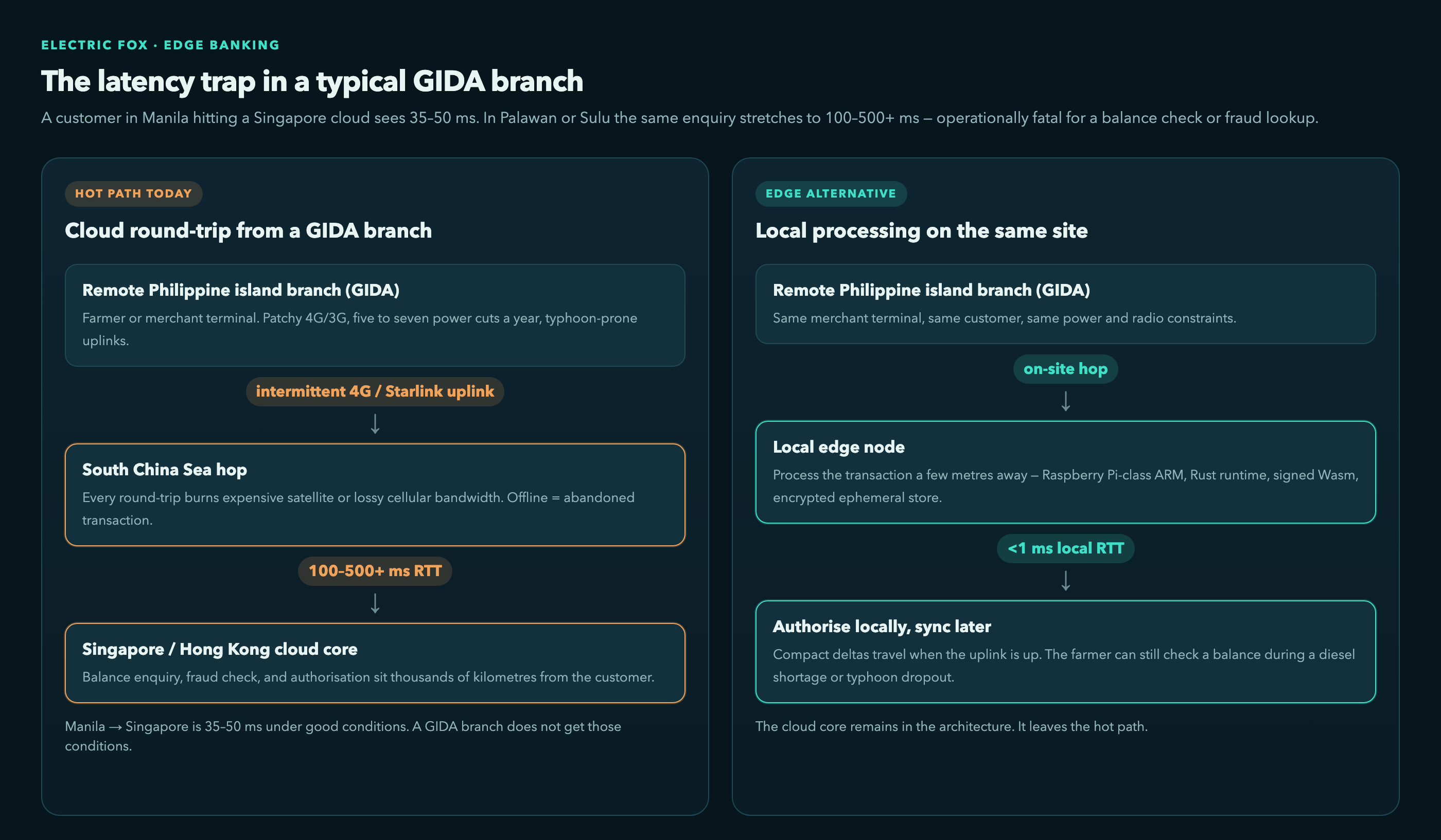
None of this is news to the BSP. Its National Strategy for Financial Inclusion 2022–2028 explicitly calls for innovative delivery channels and offline-capable solutions. The connectivity and infrastructure trap is not a Philippine curiosity. It is a global pattern for any nation where geography and economics conspire against fibre-to-the-home and 24/7 grid power.
Why edge computing changes the game for financial inclusion
Edge computing offers the pragmatic alternative. Process the transaction where the customer actually stands (on a low-power device a few metres away rather than a few thousand kilometres). Local handling slashes round-trip latency from hundreds of milliseconds to single digits, cuts bandwidth bills and enables true offline resilience when the link drops during the next typhoon or diesel shortage.
RCBC has already proved the model works at scale. Its ATM Go network now reaches all 82 provinces, with roughly a quarter of merchant terminals relying on Starlink satellite backhaul precisely because terrestrial infrastructure never arrived. The same logic scales far beyond the Philippines. Sub-Saharan Africa still has hundreds of millions of adults outside the formal banking system, with Nigeria alone counting more than 80 million unbanked adults in 2025. Latin America fares little better, with over a third of adults remaining unbanked and rural low-income households hit hardest.
Hardware realities make the shift practical rather than aspirational. Traditional rack servers gulp 100 W or more and demand air-conditioned rooms. Edge nodes run on ARM-based boards (think Raspberry Pi class or industrial equivalents) that sip just a few watts under load and can run for hours on a car battery or small solar setup. Real-world deployments report bandwidth reductions of 40 to 60 per cent when most logic moves to the edge, while offline resilience cuts the operational risk that forces banks to abandon rural markets.
Rust as the foundation for secure performant edge banking
Rust sidesteps the entire mess of traditional fintech backends. It delivers memory safety without a garbage collector, zero-cost abstractions that compile straight to native code, and effortless cross-compilation for the motley collection of edge hardware found in geographically isolated areas. Microsoft and Google both report that around 70 per cent of serious vulnerabilities stem from memory-safety issues; Rust eliminates entire classes of these bugs at compile time.
Performance and resource discipline matter just as much when the power supply is intermittent. Rust binaries for simple services often weigh in at a few hundred kilobytes to a couple of megabytes, while the same workload in Java can easily tip into tens of megabytes before any business logic appears. Adoption numbers reflect the shift: as of 2025, 45.5 per cent of organisations reported non-trivial use of Rust in production, with job postings mentioning the language up more than 300 per cent in three years.
WebAssembly for sandboxed portable execution on the edge
WebAssembly changes the script entirely. It delivers a lightweight, sandboxed execution layer that lets banks ship secure, modular code to the edge without dragging in a full operating system or burning through scarce watts and bandwidth. Compiled once from Rust, it executes inside a strict sandbox with deny-by-default capabilities via the WebAssembly System Interface. Edge runtimes such as WasmEdge deliver cold starts in the 20 to 100 ms range and memory footprints measured in tens of megabytes rather than hundreds.
Over-the-air updates become almost trivial. A typical Wasm module weighs a few hundred kilobytes to a couple of megabytes and can be swapped in without rebooting. The combination is already appearing in production fintech workloads, enabling on-device biometrics, lightweight fraud detection and AI while keeping sensitive data local. For underbanked communities the payoff is immediate: a farmer in a Visayan GIDA can complete a transaction in milliseconds even when the satellite link is dark.
Data strategies: local encryption ephemeral stores and minimal synchronisation
Most data stays where the customer is, encrypted at rest in a SQLCipher-wrapped SQLite store or truly ephemeral in-memory structures that vanish on power loss. Synchronisation is deliberately minimalist: the edge node queues every change as a compact delta of a few kilobytes. When connectivity returns, only that delta travels. Bandwidth consumption drops by 40 to 60 per cent compared with chatty cloud APIs, and the attack surface shrinks because the constant outbound flow that feeds most cloud breaches is simply not there.
The regulatory fit is clean. The Data Privacy Act does not mandate full data localisation; it insists on reasonable technical measures. BSP Circular No 982 encourages risk-based approaches that favour resilience over constant connectivity. Real-world numbers underline the advantage: Philippine threat reports for 2024-2025 show data leaks and exposures as a top incident category, while global breach-cost studies place multi-environment incidents at roughly USD 5 million on average.
Hybrid operations resilience and deployment at scale
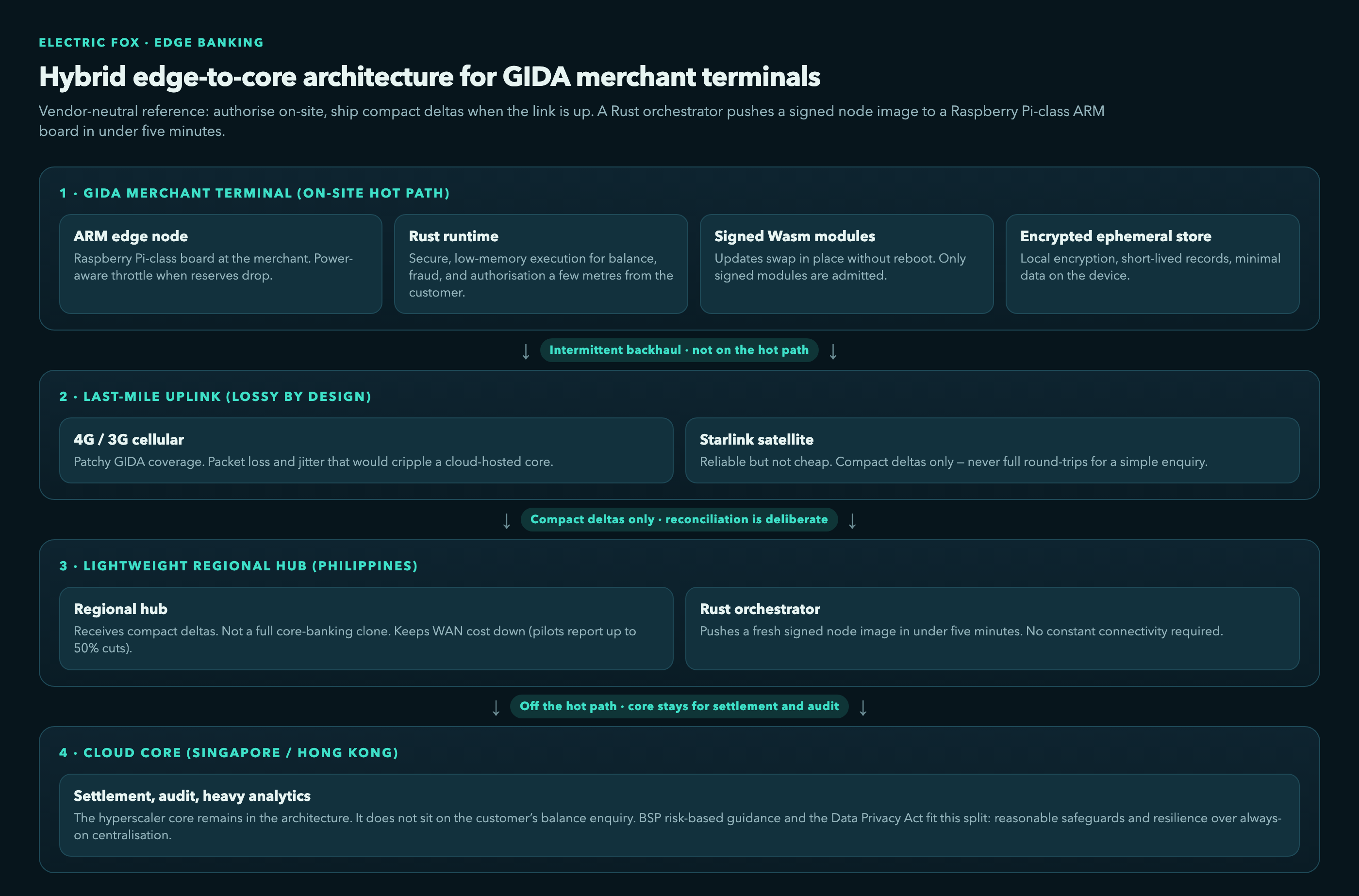
Hybrid operations turn the operational headache of thousands of edge nodes into something repeatable and resilient. A Rust-based orchestrator pushes a fresh node image to a Raspberry Pi-class ARM board in under five minutes. Power monitoring is baked in, throttling non-essential modules when reserves drop. Updates arrive via signed Wasm modules that swap in place without rebooting. Reconciliation stays minimal and deliberate: only compact deltas travel to a lightweight regional hub.
Banks running similar hybrid pilots report WAN costs slashed by up to 50 per cent and transaction success rates climbing from the low 50s per cent to over 95 per cent. The high-level reference architecture is brutally simple and deliberately vendor-neutral. The BSP’s National Strategy for Financial Inclusion already nods toward exactly this model. The same playbook works in Indonesia’s outer islands, rural sub-Saharan Africa or the scattered communities of Latin America.
Security compliance and risk management in decentralised models
Chief technology officers and chief information officers in Philippine banks have heard the pitch a thousand times: centralise everything in Singapore or Hong Kong and let the hyperscalers handle the heavy lifting. Yet the numbers tell a different story. In 2025 the Bangko Sentral ng Pilipinas recorded 1.3 million breached accounts across the country.
In 2025 the Bangko Sentral ng Pilipinas recorded 1.3 million breached accounts across the country
Rust’s memory safety guarantees and Wasm’s strict sandbox deliver zero-trust principles baked into the code. Encryption at rest uses AES-256 with per-device keys, data in transit uses TLS 1.3, and ephemeral stores wipe on power loss. Every local transaction is logged in a tamper-evident append-only structure. When a node is compromised the blast radius stops at the barangay level.
Global scalability lessons and roadmap for adoption
The Philippine laboratory has settled the argument once and for all. Copying the Singapore or Hong Kong centralised-cloud template is actively hostile to genuine financial inclusion in any market where geography, patchy grids and intermittent links are the daily reality. The edge-centric model built on Rust, WebAssembly, encrypted local stores and satellite backhaul is the scalable template that finally matches the physics of the places the underbanked actually live.
Sub-Saharan Africa still has roughly 42 per cent of adults unbanked (some 420 million people). Latin America and the Caribbean have 122 million adults still unbanked. Starlink is already live in 27 African countries and on track for 45 by the end of 2026. A practical three-phase roadmap turns the proof into repeatable deployment: a contained proof of concept, a 200-to-500-node regional pilot, then national rollout and cross-border federation. Total timeline from first PoC to nationwide coverage is 18 to 24 months.
Forward-looking considerations sharpen the advantage. Satellite technology is accelerating with direct-to-cell capabilities already in live testing. At the same time edge AI is moving from experiment to production, with the market growing at over 30 per cent compound annual rate. The underbanked in Africa and Latin America do not need another Singapore-style data-centre skyscraper. They need banking infrastructure that survives the next power cut, the next monsoon and the next satellite hand-off. The Philippine edge model has already proved it can do exactly that at scale.